
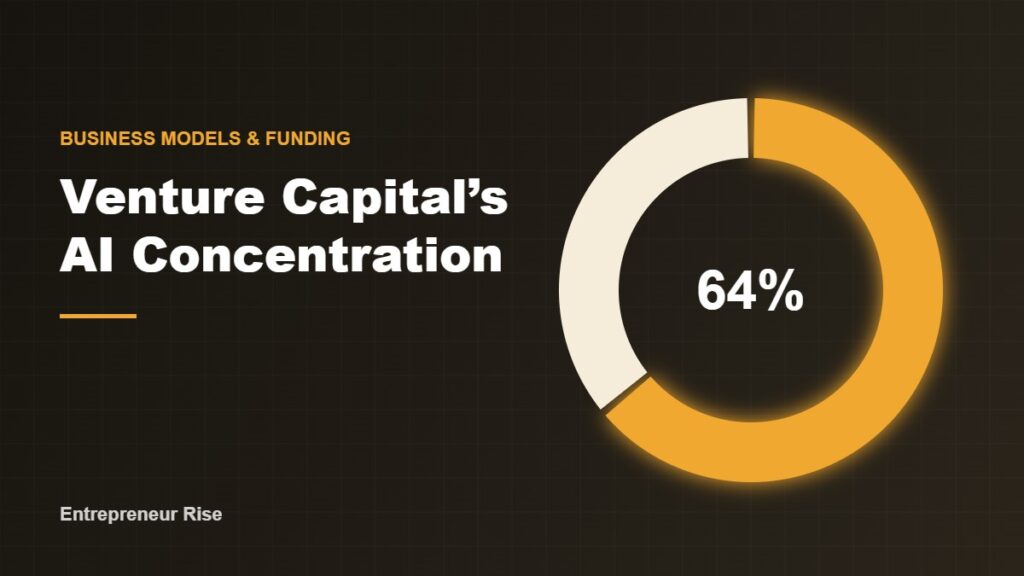
Global venture capital had a record-setting third quarter in 2026, but only if you are an AI company. According to Crunchbase, startups raised $159 billion in Q3 2026, and AI companies took $102 billion of it, or 64%. A record 27 companies raised rounds of $1 billion or more. For the thousands of founders building outside AI, or building AI applications without frontier-model budgets, the data raises a practical question: how do you finance a business in a market this concentrated?
The Q3 2026 numbers
Crunchbase’s quarterly report, with data as of early October 2026, shows:
- $159 billion in global venture funding across close to 6,000 startups.
- Down 25% from $212 billion in Q2 2026, but up 53% from $104 billion in Q3 2025.
- $102 billion (64%) went to AI startups.
- 27 companies raised $1 billion-plus rounds, an all-time record, up from 16 in Q2 and 14 in Q1. Around a third of all global venture capital went to those 27 companies.
- $679 billion raised in the first nine months of 2026, the highest three-quarter total on record.
Regionally, North American startups raised $92 billion in Q3, down 35% from Q2, with AI companies capturing $61 billion of it.
Different trackers, same picture
Funding totals vary by methodology. KPMG’s Venture Pulse counted $170.9 billion across 8,341 deals in Q3 and $728.3 billion for the first nine months. CB Insights data, cited by Fintech News Switzerland, put Q3 at $187.2 billion while deal count fell to a record low. The figures differ, but every tracker agrees on the direction: more money, fewer companies, and AI megadeals at the centre.
What concentration means for everyone else
When one-third of all venture capital goes to 27 companies, the rest of the market competes for a smaller pool. Emerging markets feel this most. MAGNiTT data shows MENA startup funding fell 22% year over year in H1 2026, and African startups completed far fewer deals than a year earlier, as we explain in our coverage of the 2026 Global Startup Ecosystem Report.
The practical effects for founders include:
- Higher bars for traction. Investors with abundant AI deal flow can be selective elsewhere.
- Longer fundraising cycles for non-AI companies and for early-stage rounds.
- Pressure to “add AI” to pitches, even where it is not central to the business.
- More consolidation, as companies that cannot raise choose to merge or be acquired.
Financing options beyond the venture spotlight
Revenue first, then capital
Businesses that reach profitability or near-profitability negotiate from strength. In tight markets, customers are the cheapest source of capital.
Debt and revenue-based financing
For companies with predictable revenue or physical assets, debt can fill the gap. In Africa, debt made up a growing share of startup financing in 2026; e-mobility company Spiro, for example, combined a $50 million Afreximbank facility with equity rounds, as covered in our article on Africa’s electric two-wheeler shift.
Strategic investors and partners
Corporate partners can provide capital, distribution and eventually an exit. The path from partnership to acquisition followed by InstaDeep and BioNTech is a well-known example.
Specialist and regional funds
Impact funds, development finance institutions and sector-specialist investors often follow different cycles from generalist VC. Spiro’s $215 million round, led by Impact Fund Denmark and Equitane, shows how large these cheques can be.
M&A as a growth tool
Acquiring a smaller competitor or merging with a complementary company can deliver growth that new capital cannot. We examine that trend in why M&A became a growth strategy for African startups.
How to position your company in this market
- Be precise about AI. Explain what AI actually does in your product or operations, and what measurable difference it makes. Vague claims are easy for experienced investors to see through.
- Show capital efficiency. Revenue per employee, gross margin and payback periods matter more when capital is selective.
- Extend runway before you need to. Plan for fundraising taking longer than expected.
- Match capital to model. Not every business should be venture-funded. Asset-heavy, steady-growth or local-market businesses may be better served by debt, strategic or regional capital.
Conclusion
Q3 2026 confirms that venture capital is pouring into AI at record scale while the number of funded companies shrinks. That is not the whole market, though. Founders who understand the concentration, prove their economics and choose financing that fits their business model can still build, and sometimes build more durably, outside the spotlight.
Sources
- Crunchbase News Q3 2026 global funding report, as summarised by AI Weekly and FourWeekMBA
- KPMG, AI megadeals dominate venture capital and Venture Pulse Q3 2026
- Let’s Data Science, CB Insights Q3 2026 data
- Angel Investors Network, Q3 2026 Startup Funding
- Arab News, MENA venture funding H1 2026 (MAGNiTT)

Comments