
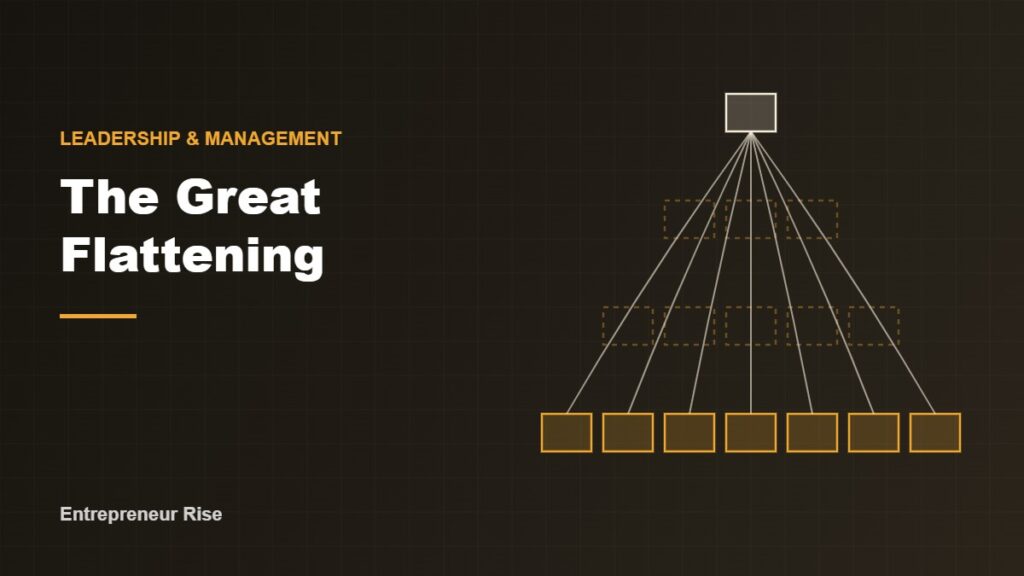
Few roles have been questioned as much in the AI era as the middle manager. Companies have removed management layers, citing AI tools that now handle scheduling, reporting and status tracking. Yet a growing body of 2026 research suggests that cutting managers too far can backfire, both for AI adoption and for the leadership pipeline. For founders and executives designing their organisations, this “Great Flattening” deserves a careful look.
What the data shows
- Flattening is widespread but not universal. Korn Ferry’s survey of 15,000 professionals worldwide found that around 41% of employees say their companies trimmed management layers in the previous year, according to Fortune. Fortune also noted that the trend remains far from mainstream.
- Analysts expected more. Gartner predicted that in 2026, 20% of organisations would use AI to flatten their structures, eliminating more than half of their current middle management positions.
- Managers were already a target. A Bloomberg analysis of Live Data Technologies data found middle managers accounted for roughly a third of layoffs in 2023, up from about 20% in 2019.
- Large cuts are happening. Payments company Block cut more than 4,000 jobs in February 2026, reducing its workforce from over 10,000 to just under 6,000, according to Deel.
The case for flattening
AI tools now automate many tasks that once filled a manager’s day: collecting updates, compiling reports, scheduling and tracking progress. Removing layers can speed decisions, reduce overhead and bring leaders closer to the work. For startups, a flat structure has always been the default, and many founders see AI as a way to keep it longer as they grow.
The case against cutting too deep
AI adoption depends on managers
Microsoft’s 2026 Work Trend Index concluded that organisational factors, including culture, manager support and talent practices, account for twice the reported AI impact of individual effort alone. A Salesforce survey of managers conducted in March 2026 found that 48% feel pressure from leadership to demonstrate AI adoption, yet only 32% work in organisations that formally track it.
Executives inherit the workload
When the middle disappears, coordination does not. Fortune reported executives feeling overwhelmed as management layers vanish, with decisions and people issues moving upward.
The leadership pipeline breaks
Middle management is where future senior leaders learn to lead. Removing it can leave companies without experienced leaders a few years later, and signals to ambitious employees that management is a disposable career path.
Survivors are stretched
Managers who remain often lead larger teams with less support, which raises burnout risk and reduces the time available for coaching.
Alternative approaches
Some companies have chosen to retrain rather than remove. SHRM cited Infosys, which publicly committed to avoiding mass layoffs and retrained more than 250,000 employees on AI and automation tools. The broader lesson is to separate bureaucracy from leadership: remove reporting layers that only relay information, but invest in managers who develop people and lead change.
A practical framework for founders and leaders
- Map what managers actually do. List tasks by category: coordination and reporting, decision-making, people development, and change leadership. AI handles the first category best and the last two poorly.
- Automate the administrative layer first. Use AI for status updates, meeting notes and reporting before removing any roles.
- Set sensible spans of control. Decide how many direct reports a manager can coach well, and design teams around that number rather than an arbitrary target.
- Make managers responsible for AI adoption. Give them the tools, training and measurement to lead it, since the research shows they drive results.
- Protect the pipeline. Keep clear paths for employees to grow into leadership, even in a flatter structure.
- Measure outcomes after restructuring. Track decision speed, engagement, attrition and executive workload, not just cost savings.
What this means for growing companies
Startups scaling past their first few dozen employees face the same question from the opposite direction: when should they add management? The 2026 evidence suggests adding managers who lead change and develop people, while using AI to avoid a layer of pure coordination. Growth-stage companies that get this balance right can scale with fewer layers without losing leadership depth. For more on scaling decisions, see our coverage of growth through consolidation.
Conclusion
AI is changing what managers do, but the evidence does not support the idea that managers are becoming unnecessary. Organisations that remove administrative work while investing in the people side of management are more likely to succeed with AI, and to have leaders ready when they need them.
Sources
- Fortune, AI agents are flattening corporate hierarchies (June 9, 2026)
- Fortune, Executives are drowning. Blame the vanishing middle management layer
- Salesforce, Middle managers are more vital than ever in the age of AI
- O’Reilly Radar, on Microsoft’s 2026 Work Trend Index
- SHRM, How AI is transforming the roles of middle managers (Gartner prediction)
- SHRM, Why midmarket CEOs should rethink the “more AI + more layoffs” equation
- Deel, The Middle Manager Paradox
- Rework, The Middle Manager in the Age of AI (Bloomberg / Live Data Technologies analysis)
Comments